Education supplement feature on students choosing local universities. [Date note: month precision, low confidence; source: 4 inferred ("this month" as students leave for university). Nominal date; check later: supplement issue date; page 1 only has the year.]
[Unproofed OCR transcript, read by machine from the scan]
cS qa ESSEX SI Making Local Matter More Since 1764
CHRONIC
LE
EDUCATIC
IN Essex 2005.
Your guide to lea
rning in the county
thisisessex.com/supplements
ESSEX Si
CHRONICLE
Home or aw
Katy Fisher investigates the trend for students to go to university closer to home
WHILE hordes of students get ready to decamp to other parts of the country this month, an increasing number will be studying at universities closer to home.
Completing a three year degree now costs nearly £27,000, according to recent figures, and students can be expected to be saddled with more than £15,000 debt.
But staying put and commuting to university is helping many to cut out expenses including costly rent and the trend could increase all the more in 2006 when tuition fees take a leap.
Institutions across Essex are certainly noticing the trend, not least University of Essex, which is reporting a dramatic rise in undergraduate entries from across the county.
Head of undergraduate admissions and student recruitment, Mike Nicholson says the university has experienced a 29 per cent increase in those coming from schools and colleges in central Chelmsford and a 28 per cent rise in students from Brentwood from 2002 to 2005.
Meanwhile there has been a huge rise of 84 per cent in those attending from Rayleigh and Basildon.
“tn 1998 when tuition fees first came in that’s when we noticed an increase in interest from local students and from next year I have my suspicions it may become a lot more sensible to stay more local,” says Mr Nicholson, who points out that applications from private and grammar school pupils are also on the up.
But the opportunity to save money isn’t the only reason students are looking on their doorsteps for higher education, says Mr Nicholson, who credits the wider range of courses the university has introduced as helping to turn the heads of homegrown school leavers.
“Research that we have conducted indicates that students are much more likely to consider course content and academic opportunities before they look too closely at the costs of attending,” he says.
It’s a similar story at Chelmsford's Anglia Polytechnic University and Writtle College, which are both recruiting more students from the area. 64 per cent of APU's undergraduate applications this year have come from Essex and London. Writtle last year recruited exactly the same percentage from East Anglia.
Prof lan Cumbus, assistant principal at Writtle College, says: “There is an increasing trend, driven largely by the economics of going to university. As we are quite specialist, in terms of those subjects, students have a few choices of where they can study, but we are finding more students from the region are coming to us.”
Increasing opportunities to combine work with part time study had helped, he adds.
And of course Essex isn’t the only option for students, as most are within reasonable commuting distance of London’s plethora of universities, although travel costs might be a put off for those trying to save cash.
Another consideration is Open University (OU), and no, students won't find themselves in the company of just housewives and full-time workers.
?
{90 ak 060905 02 01
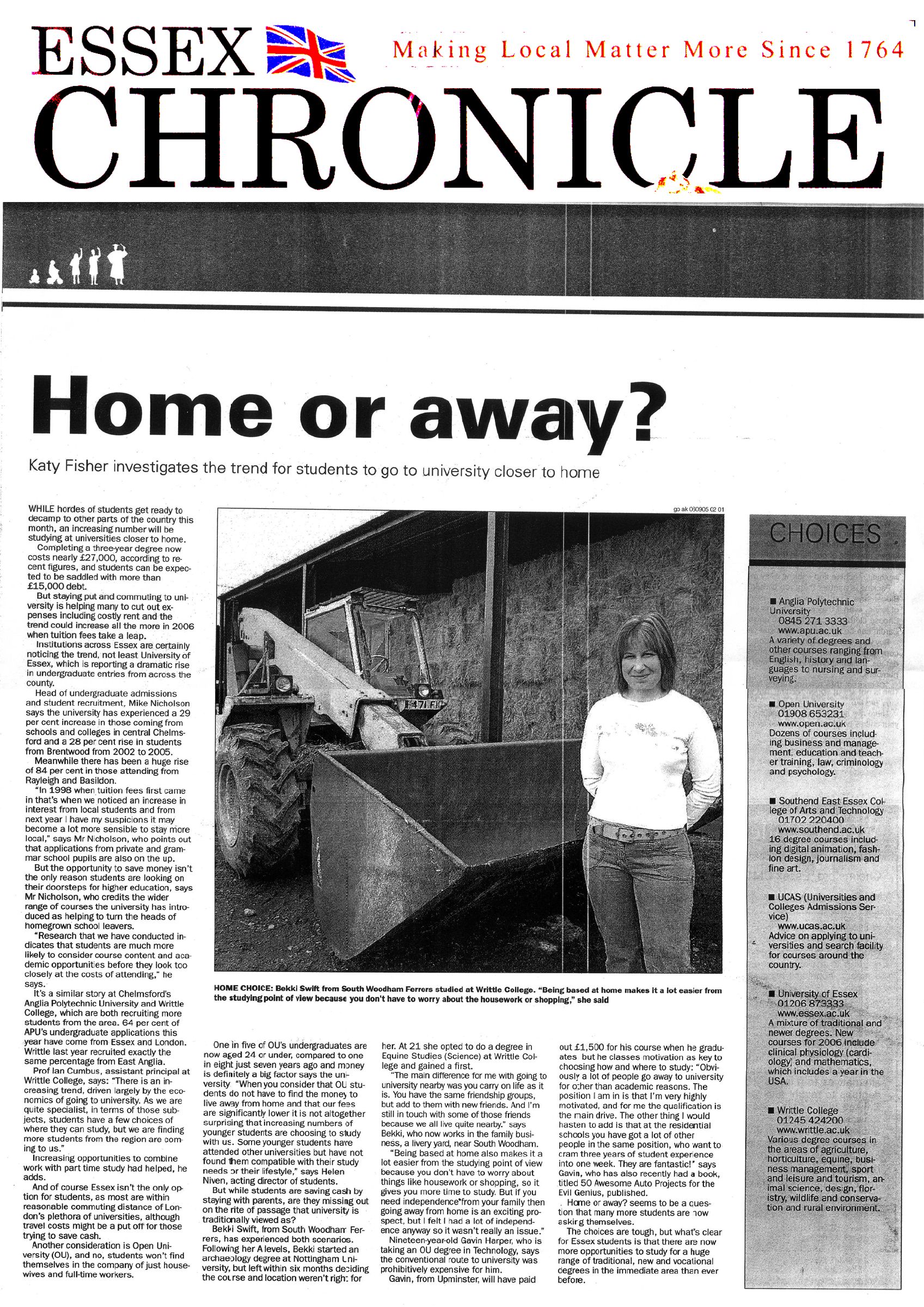
HOME CHOICE: Bekki Swift from South Woodham Ferrers studied at Writtle College. “Being based at home makes it a lot easier from the studying point of view because you don't have to worry about the housework or shopping,” she sald
One in five of OU's undergraduates are now aged 24 or under, compared to one in eight just seven years ago and money is definitely a big factor says the un+ versity: “When you consider that OU students do not have to find the money to live away from home and that our fees are significantly lower it is not altogether surprising that increasing numbers of younger students are choosing to study with us, Some younger students have attended other universities but have not found them compatible with their study needs or their lifestyle,” says Helen Niven, acting director of students.
But while students are saving cash by ‘Staying with parents, are they missing out on the rite of passage that university is traditionally viewed as?
Bekki Swift, from South Woodham Ferrers, has experienced both scenarios. Following her A levels, Bekki started an archaeology degree at Nottingham University, but left within six months deciding. the course and location weren't right for
her. At 21 she opted to do a degree in Equine Studies (Science) at Writtle College and gained a first.
“The main difference for me with going to university nearby was you carry on life as it is. You have the same friendship groups, but add to them with new friends. And I'm still in touch with some of those friends because we all live quite nearby.” says Bekki, who now works in the family business, a livery yard, near South Woodham.
“Being based at home also makes it a lot easier from the studying point of view because you don't have to worry about things like housework or shopping, so it gives you more time to study. But if you need independence'from your family then going away from home is an exciting prospect, but | felt | had a lot of independence anyway so it wasn't really an issue.”
Nineteen-year-old Gavin Harper, who is taking an OU degree in Technology, says the conventional route to university was prohibitively expensive for him.
Gavin, from Upminster, will have paid
out £1,500 for his course when he graduates, but he classes motivation as key to choosing how and where to study: “Obviously a lot of people go away to university for other than academic reasons. The position | am in is that I'm very highly motivated, and for me the qualification is the main drive. The other thing | would hasten to add is that at the residential schools you have got a lot of other people in the same position, who want to cram three years of student experience into one week. They are fantastic!” says Gavin, who has also recently had a book, titled 50 Awesome Auto Projects for the Evil Genius, published.
Home or away? seems to be a question that many more students are now asking themselves.
The choices are tough, but what's clear for Essex students is that there are now more opportunities to study for a huge range of traditional, new and vocational degrees in the immediate area than ever before.
@ Open University
» 01908 653231 ‘www.open.ac.uk
Dozens of courses includ-
ing business and manage-
ment, education and teach-
er training, law, criminology
and psychology.
@ Southend Fast Essex Col-
lege of Arts and Technology 01702 220400 “www.southend.ac.uk
16 degree courses includ-
ing digital animation, fash-
jon design, journalism and
fine art.
UCAS (Universities and
Colleges Admissions Ser-
vice) sees
WWW.UCAS.aC.UK > Advice on applying to uni-
* — versities and search facility for courses around the
How to cite this coverage
/publicity/newspaper-articlesHome or away (Education in Essex 2005 supplement)Essex Chronicle2005-09-01English