Career profile of a technical author studying with the OU and the CAT masters. [Date note: day precision, medium confidence; source: 2 file name. Nominal date; check later: page carries no date.]
[Unproofed OCR transcript, read by machine from the scan]
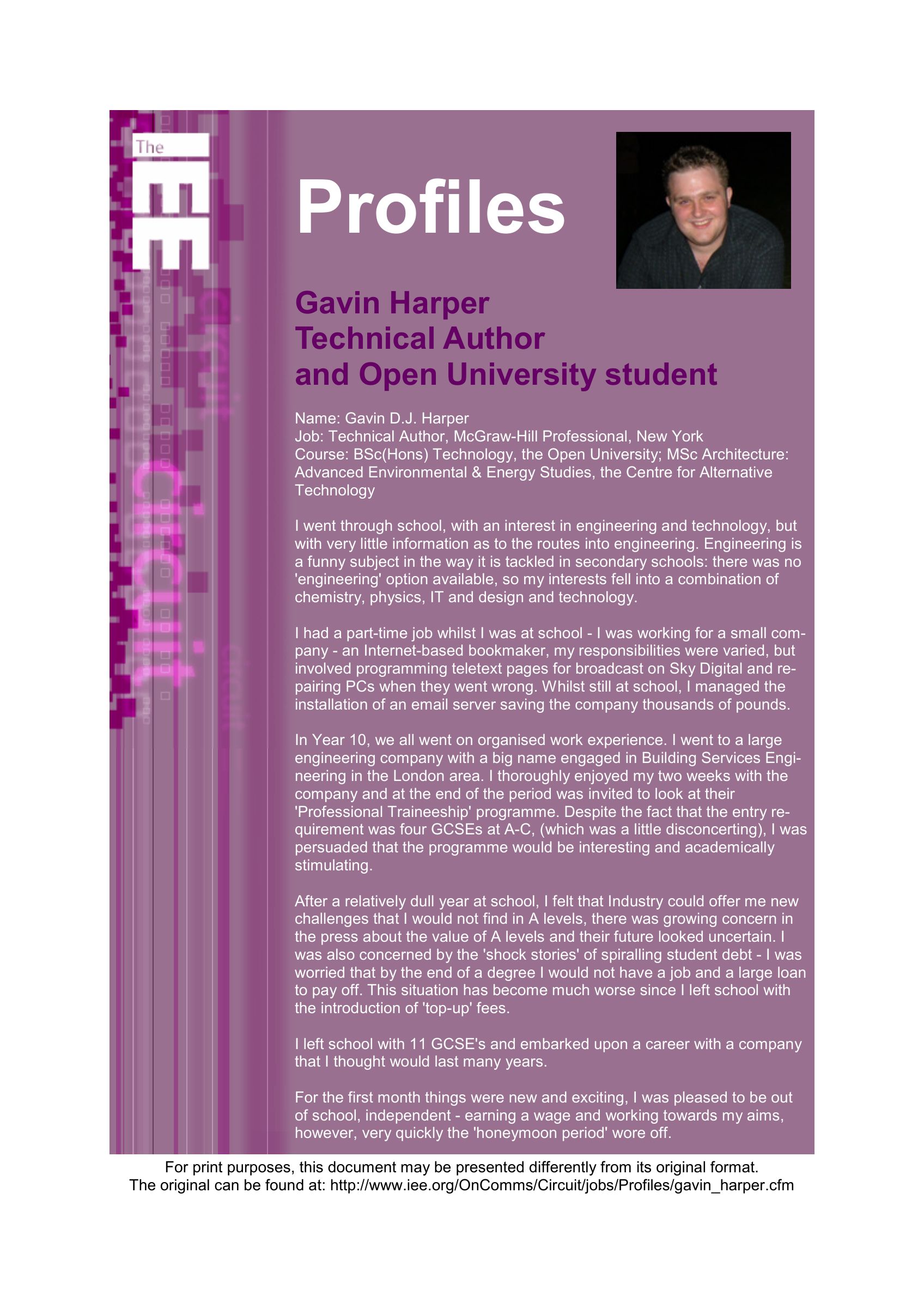
Profiles Gavin Harper Technical Author and Open University student Name: Gavin D.J. Harper Job: Technical Author, McGraw-Hill Professional, New York Course: BSc(Hons) Technology, the Open University; MSc Architecture: Advanced Environmental & Energy Studies, the Centre for Alternative Technology I went through school, with an interest in engineering and technology, but with very little information as to the routes into engineering. Engineering is a funny subject in the way it is tackled in secondary schools: there was no 'engineering' option available, so my interests fell into a combination of chemistry, physics, IT and design and technology. I had a part-time job whilst I was at school - I was working for a small company - an Internet-based bookmaker, my responsibilities were varied, but involved programming teletext pages for broadcast on Sky Digital and repairing PCs when they went wrong. Whilst still at school, I managed the installation of an email server saving the company thousands of pounds. In Year 10, we all went on organised work experience. I went to a large engineering company with a big name engaged in Building Services Engineering in the London area. I thoroughly enjoyed my two weeks with the company and at the end of the period was invited to look at their 'Professional Traineeship' programme. Despite the fact that the entry requirement was four GCSEs at A-C, (which was a little disconcerting), I was persuaded that the programme would be interesting and academically stimulating. After a relatively dull year at school, I felt that Industry could offer me new challenges that I would not find in A levels, there was growing concern in the press about the value of A levels and their future looked uncertain. I was also concerned by the 'shock stories' of spiralling student debt - I was worried that by the end of a degree I would not have a job and a large loan to pay off. This situation has become much worse since I left school with the introduction of 'top-up' fees. I left school with 11 GCSE's and embarked upon a career with a company that I thought would last many years. For the first month things were new and exciting, I was pleased to be out of school, independent - earning a wage and working towards my aims, however, very quickly the 'honeymoon period' wore off. For print purposes, this document may be presented differently from its original format. The original can be found at: http://www.iee.org/OnComms/Circuit/jobs/Profiles/gavin_harper.cfm
It became apparent that the degree course I was initially offered at an accredited university with a good reputation, had been replaced by a nonaccredited course at an institution with a lesser reputation. This set alarm bells ringing - not the change of degree being the worrying element, but the fact the company had already started to renege on their promises. After a very short time, I began to find that the time at work was becoming dull, I was happy to get involved and help the people around me although the 'structured' training programme that I was promised was not evident. There were no goals to work towards, and no one seemed to notice when the trainees around me were whiling away the hours playing 'Championship Manager'. Bored at work, I contacted the 'Open University' to see if I could study for a qualification part-time. The OU does offer a BEng programme, however, as I was already promised BEng sponsorship, I decided to study towards a BSc(Hons) Technology, as I felt that the qualifications were complimentary without overlap. I began studying with the OU in trepidation, fearful as to whether I would be able to deal with 'degree level' study without any experience at A level. Quickly my fears were allayed, the Open University learning material was so clearly presented and well-explained that I quickly found myself understanding complex concepts with relative ease. Although the University is traditionally seen as being for people in the middle of their careers, the tide is quickly turning. This year the Open University announced that 20% of new enrolments were students aged 24 or under. The OU was challenging, exciting. By contrast my work during the day had not lived up to my expectations as the training was not in place. A little disillusioned, I began to explore my options. I felt that if I were to stay on with the company there was little room for progression at a rate I felt comfortable with but then I was also concerned that if I went back to school, I would be a year behind and face the same problems had I stayed on. I spoke to the human resources officer to see if I could accelerate my learning or training in any way but there was no flexibility. In retrospect, had I worked for a smaller engineering firm, I believe my industrial training would have been better as their is a greater reliance on getting the best performance from the staff, I just felt lost in a big uncaring company that was not responsive to my individual training needs. In the end, it was a hard decision, but I decided to leave the firm. I was concerned that I needed further qualifications to 'plug the gap' between GCSE and degree level so I approached a local college to see if I could do a couple of A levels as an external candidate. Coupled with the BTEC National that I was well on the way to finishing which provided me with an equivalent to the four A level requirement, I was on a par with my peers. Doing A levels as an external candidate was a good way to get things done as it meant that I could cram both years into one and get more done. I also went to various local colleges and enrolled on part-time courses to For print purposes, this document may be presented differently from its original format. The original can be found at: http://www.iee.org/OnComms/Circuit/jobs/Profiles/gavin_harper.cfm
build up some competences in engineering. I have worked towards Level 4 in the City and Guilds suite of Computer Aided Design qualifications, as well as working towards some NVQs in metalwork. I think it is important to have practical knowledge to underpin knowledge of theory and academic study. Around September 2004, I began to think that there was a book that could be written about in-car electronics that promoted practical modifications that you could construct yourself. There were many people on the Internet with personal web pages about putting PCs in their cars, but there was no definitive reference manual that spelt out how to do it. Spotting a corner in the market that I could make my own, I contacted McGraw-Hill Professional in New York, after extensive amounts of paperwork, they decided to offer me a contract. The rest as they say is history! This year has now drawn to an end and I have finished all of my qualifications below degree level. I am getting excited as I now have my first book published, I am busy writing another one which should be finished as you read this - 'Build Your Own Car PC' (September 2005), and another '50 Model Rocket Projects for the Evil Genius' which should be finished for the end of the year. I also have some exciting projects with McGraw-Hill for 2006. I will be meeting the President of White Box Robotics, Thomas Burick, at the end of the month to look at some of the modular robots he is building. Watch this space for 'Build Your Own PC BOT'. Next academic year promises to be exciting. With nothing to do during the day in terms of study, I have looked at the best way to fill my time. I will be studying towards an MSc in Architecture with Advanced Environmental & Energy Studies at the Centre for Alternative Technology alongside the third year of my degree. This seemed like an efficient way to get things done. I will be looking to use some of my study with the OU towards a BEng upon completion of my BSc. On reflection, I have found the way I have done things to suit my independent style of working. To those who would knock the OU, I am quick to remind them that the Open University is ranked fifth of all UK universities for teaching quality in the Sunday Times University Guide 2004; a ranking higher than those for Oxford and University College London. More than 1000 academics are involved in writing materials and in research that ranges from e-learning to space sciences. Another 8000 associate lecturers provide personal tuition to more than 200,000 students. Since its beginning in 1971, more than two million people have studied Open University degree, diploma, certificate and stand-alone courses. For young people, the OU offers a financially sound alternative to the conventional route through university. With a conventional university, your parents income is assessed which results in many people having to pay expensive fees if they are not being sponsored by an employer. With the OU, it is the student's income that is taken into consideration - for many young students this means that they can get a full financial award. A full award would give you a grant of £590 towards your course fees, if you are studying 30 to 60 credit points worth of courses, and £885, if you are studying 90 or more credit points worth of courses and a supplementary For print purposes, this document may be presented differently from its original format. The original can be found at: http://www.iee.org/OnComms/Circuit/jobs/Profiles/gavin_harper.cfm
payment for books and materials worth £250 which will cover their course fees in their entirety. You do not even miss out on the university lifestyle with the OU, as their summer residential schools give you a chance to carry out practical laboratory work in an academic setting, whilst cramming three years of university social life into a week! Over the course of an OU BEng, you can expect to do at least two of these summer schools which are great fun. For students looking to work towards professional recognition, the OU BEng is currently being scrutinised by a number of engineering institutions to see if they can offer accreditation, however, the IEE amongst other institutions publishes guidelines which if you adhere to when selecting courses for your BEng will allow you to have your qualifications accepted under the individual recognition route to Chartered/Incorporated engineer status. Whilst at one of my Open University Summer Schools, I got the chance to speak to one of the senior members of the IEE who was examining whether to accredit the OU BEng. In all dealings with IEE members, I have found that they are always ready to encourage younger members and people that want to break into the industry. IEE Student membership gives you the chance to network with people that have 'been in your shoes' and can understand where you are trying to get. The IEE has been an invaluable source of information as a young engineer. The Internet resources are invaluable for research, and I have found myself referring to IEE Review in a number of projects. Becoming a member of an institution is a worthwhile endeavour as it helps keep you up to date with changes in technology and the latest advances. Looking to the future, I would like to work towards Professional Registration once I have completed my studies. The IEE and the OU have both been incredibly helpful with respect to giving me advice on the routes into engineering. At the moment I am employed by McGraw-Hill as a Technical Author, I expect this relationship to last for many years as it enables me to combine a subject that I love, electronics, with an interesting career that throws up new challenges. As a result of my writing, I have formed links with industry, and will be working closely with the Taiwanese motherboard manufacturer VIA, in finding new applications for their Mini-ITX products. We are entering an exciting period, the distinction between home HiFi, video, Internet access, communication and entertainment are rapidly being eroded. We are now seeing ever more integrated multi-functional devices that build on the strength and versatility of the PC architecture. No longer is a PC used for typing and the television used for watching videos. We can now watch DVDs on our laptops and surf the Internet through our televisions. Developing projects that hobbyists, and people with an interest in electronics can build themselves at home with relative ease is something that I find exciting. This year I will be completing my BSc(Hons) Technology with the OU, I intend to complete some additional study afterwards to also gain the BEng qualification. For print purposes, this document may be presented differently from its original format. The original can be found at: http://www.iee.org/OnComms/Circuit/jobs/Profiles/gavin_harper.cfm
How to cite this coverage
/publicity/magazines-periodicalsCircuit career profileThe Institution of Electrical Engineers (IEE) - Circuit2005-08-10http://www.iee.org/OnComms/Circuit/jobs/Profiles/gavin_harper.cfmEnglish